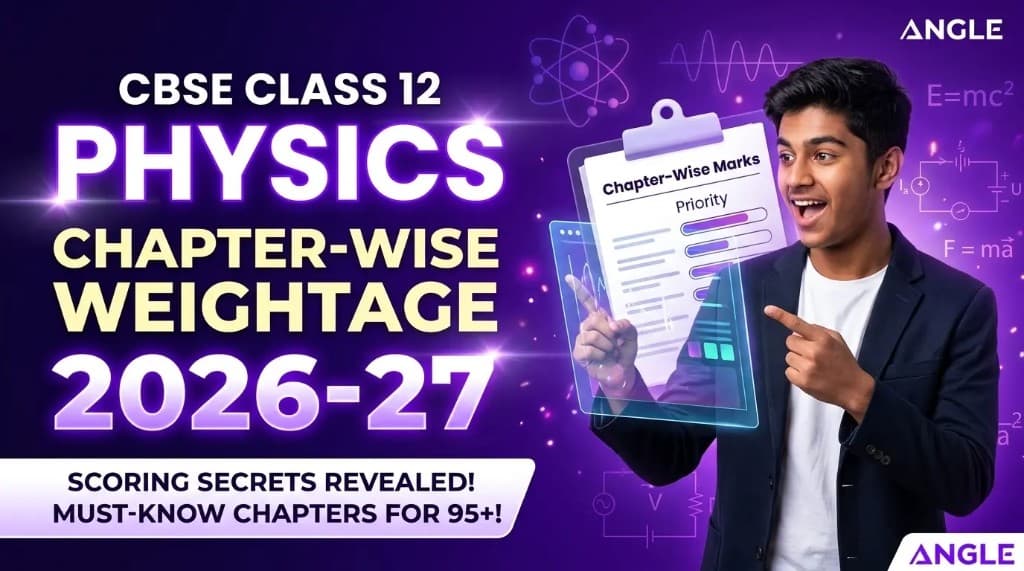
CBSE Class 12 Physics Weightage 2026 – 27: Chapter-Wise Marks
- Updated on
 Ashique Muhammed
CBSE Class 12 Physics weightage shows how the 70 theory marks are spread across the syllabus. In this guide, you will find the official marks for each group of chapters, chapter-wise weightage, the paper pattern, practical marks and how to prepare for each chapter for the CBSE Class 12 board exam.
Key takeaway
CBSE gives theory marks for five groups of chapters only: 16, 17, 18, 12 and 7, out of 70. Every chapter-wise number you see online is an estimate. Ray Optics (about 10 marks) and Semiconductor Electronics (7 marks) carry the most estimated marks, but the whole syllabus is examined.
- Chapter Wise Weightage 2026-27
- How many marks does each part of the Physics syllabus carry?
- Which Physics chapters should you study first?
- What is the paper pattern, and how do competency-based questions fit?
- Which topics, laws and question types matter in each chapter?
- How are the 30 practical marks split?
- Frequently asked questions
Chapter Wise Weightage 2026-27
The chapter with the highest estimated weightage is Chapter 9, Ray Optics and Optical Instruments, at about 10 marks.
This cbse physics chapter wise weightage class 12 table lists the estimated marks for all 14 chapters, out of 70 theory marks. CBSE does not publish chapter-wise marks officially, so use these figures to set your study order and revise every chapter, not as promises of what will actually appear.
| Ch | Chapter | Estimated marks |
|---|---|---|
| 1 | Electric Charges and Fields | 5 |
| 2 | Electrostatic Potential and Capacitance | 5 |
| 3 | Current Electricity | 6 |
| 4 | Moving Charges and Magnetism | 6 |
| 5 | Magnetism and Matter | 5 |
| 6 | Electromagnetic Induction | 4 |
| 7 | Alternating Current | 2 |
| 8 | Electromagnetic Waves | 4 |
| 9 | Ray Optics and Optical Instruments | 10 |
| 10 | Wave Optics | 4 |
| 11 | Dual Nature of Radiation and Matter | 4 |
| 12 | Atoms | 4 |
| 13 | Nuclei | 4 |
| 14 | Semiconductor Electronics | 7 |
| Total | All 14 chapters | 70 |
How to read this table: these chapter marks are estimates, not official CBSE figures. A real paper can give a chapter a few marks more or less than shown here.
How many marks does each part of the Physics syllabus carry?
CBSE Class 12 Physics (subject code 042) has 70 theory marks and 30 practical marks, and the theory marks are published only for five groups of chapters.
| Chapters | Chapter names | Official marks |
|---|---|---|
| 1 to 3 | Electric Charges and Fields; Electrostatic Potential and Capacitance; Current Electricity | 16 |
| 4 to 7 | Moving Charges and Magnetism; Magnetism and Matter; Electromagnetic Induction; Alternating Current | 17 |
| 8 to 10 | Electromagnetic Waves; Ray Optics and Optical Instruments; Wave Optics | 18 |
| 11 to 13 | Dual Nature of Radiation and Matter; Atoms; Nuclei | 12 |
| 14 | Semiconductor Electronics | 7 |
| Total | 14 chapters | 70 |
Each mark value covers the whole group of chapters in its row, not one chapter. The theory paper is 3 hours long, and the five groups add up to 70 (16 + 17 + 18 + 12 + 7).
Which Physics chapters should you study first?
Start with Ray Optics, Semiconductor Electronics, Current Electricity and Moving Charges and Magnetism, then work through the rest in the order below.
This order is a suggestion based on the estimated marks in the chapter-wise table. It only decides where you begin, so cover every chapter.
| Study order | Chapters (estimated marks) | Total estimated marks |
|---|---|---|
| First | Ray Optics and Optical Instruments (10), Semiconductor Electronics (7), Current Electricity (6), Moving Charges and Magnetism (6) | 29 |
| Second | Electric Charges and Fields (5), Electrostatic Potential and Capacitance (5), Magnetism and Matter (5), Electromagnetic Induction (4), Wave Optics (4), Alternating Current (2) | 25 |
| Third | Electromagnetic Waves (4), Dual Nature of Radiation and Matter (4), Atoms (4), Nuclei (4) | 16 |
| Total | All 14 chapters | 70 |
The whole syllabus is examined. A single weak chapter can cost as much as one full 5-mark answer. Weightage helps you decide the order, not whether to study a chapter. If you are also preparing for NEET, read how NEET coaching centres in Kerala compare before you plan entrance study alongside boards.
What is the paper pattern, and how do competency-based questions fit?
The Physics theory paper has 33 questions in five sections, A to E, for 70 marks, and the 2026-27 sample paper reports no change in design.
| Section | Questions | Type | Marks each | Total |
|---|---|---|---|---|
| A | 16 | 12 multiple-choice and 4 assertion-reason | 1 | 16 |
| B | 5 | Very short answer | 2 | 10 |
| C | 7 | Short answer | 3 | 21 |
| D | 2 | Case-based | 4 | 8 |
| E | 3 | Long answer | 5 | 15 |
| Total | 33 | 70 |
16 + 10 + 21 + 8 + 15 = 70 marks, and 16 + 5 + 7 + 2 + 3 = 33 questions.
A competency-based question (CBQ) tests whether you can apply an idea to a new situation, not only recall it. Case studies and assertion-reason questions are the clearest examples. The CBSE curriculum gives competency-based questions a substantial share of the paper. In the sample paper, the explicitly labelled items (4 assertion-reason marks and 8 case-study marks) add up to 12 marks, or 17%. That is only the labelled share, not the full competency share.
CBSE does not publish how many competency marks come from each chapter, so treat any chapter-level competency figure as a guess. For a fuller explanation of the question type, read what competency-based questions are in CBSE.
Which topics, laws and question types matter in each chapter?
The safest list is what the 2026-27 sample paper actually tested, followed by the standard Class 12 syllabus headings.
The middle column below is checked against the sample paper. The right column lists standard syllabus headings, formulas and question types to practise. Check each topic against the exclusions marked in your own NCERT before you spend time on it.
| Ch | Seen in the 2026-27 sample paper | Laws, formulas, diagrams and question types to practise |
|---|---|---|
| 1. Electric Charges and Fields | Flux through a Gaussian sphere; field inside a conductor (assertion-reason) | Coulomb's law, electric field and dipole, Gauss's law. Draw field-line diagrams. Practise flux and field for symmetric charge shapes. |
| 2. Electrostatic Potential and Capacitance | Work to bring a third charge; capacitor combinations and what capacitance depends on (5 marks); E = −dV/dr; potential of a sphere | Potential energy, equipotential surfaces, C = Q/V, series and parallel capacitors, dielectrics. Practise network numericals and the long capacitor answer. |
| 3. Current Electricity | Heaters in parallel; Wheatstone bridge; bulbs in series; electron drift; "explain why" questions on resistance and heating | Ohm's law, resistivity, drift velocity, Kirchhoff's laws, Wheatstone bridge balance. Practise circuit numericals and reasoning answers. |
| 4. Moving Charges and Magnetism | Field at the centre of a semicircular loop; ammeter shunt | Biot–Savart law, Ampère's law, force on a current-carrying wire, torque on a loop, converting a galvanometer into an ammeter or voltmeter. Practise shunt and series resistance numericals. |
| 5. Magnetism and Matter | Superconductor near a magnet; relative permeability or Gauss's law of magnetism | Bar magnet as a dipole, Earth's magnetism, dia-, para- and ferromagnetic materials. Practise short reasoning answers. |
| 6. Electromagnetic Induction | Induced current in a cylinder; magnet falling through a ring; self-inductance scaling | Faraday's law, Lenz's law, motional emf, self and mutual inductance. Practise "direction of induced current" questions. |
| 7. Alternating Current | Transformer: principle, working and losses (5 marks, with series LCR resonance as the other option) | Phasors, LCR series circuit, resonance, power factor, transformer. Draw and label the transformer diagram. |
| 8. Electromagnetic Waves | Direction of propagation; E and B in a medium | Displacement current, electromagnetic spectrum, properties of the waves. Practise relations between E, B and wave speed. |
| 9. Ray Optics and Optical Instruments | Lens in water (assertion-reason); critical angle of diamond; compound microscope or telescope (5 marks) | Reflection, refraction, total internal reflection, lens formula, lens maker's formula, prism. Draw ray diagrams for the microscope and telescope. Practise magnifying power. |
| 10. Wave Optics | Huygens' principle and wavefronts; fringe width in Young's double slit experiment; Snell's law from Huygens' principle | Huygens' principle, interference, Young's double slit, diffraction, polarisation. Practise fringe-width numericals. |
| 11. Dual Nature of Radiation and Matter | Photoelectric effect case study (with a calculation-based multiple-choice question) | Photoelectric effect, Einstein's equation, de Broglie wavelength. Practise graph-reading and stopping-potential numericals. |
| 12. Atoms | Nucleus scaled to a football; Rutherford scattering (assertion-reason); hydrogen spectrum or Bohr model | Rutherford model, Bohr model, hydrogen spectral series. Practise energy-level and wavelength numericals. |
| 13. Nuclei | Binding energy curve; binding energy per nucleon of oxygen-16 | Mass–energy relation, binding energy, fission, fusion, radioactivity. Practise binding-energy calculations. |
| 14. Semiconductor Electronics | Energy band diagrams; wearable-device case study | Energy bands, p-n junction, diode as a rectifier. Practise band diagrams and case-based reading. |
Derivations and explanations confirmed in the 2026-27 sample paper:
- Snell's law using Huygens' principle (3 marks)
- Capacitor combinations, or field and potential (5 marks)
- Compound microscope image and magnifying power (5 marks)
- Transformer principle, working and losses (5 marks)
- Energy bands of metals, insulators and semiconductors (3 marks)
- Binding energy per nucleon (3 marks)
- Ammeter shunt (3 marks)
Pages that list "25 most repeated derivations" rarely show question numbers. Use the list above as the confirmed core, and add others from your teacher's guidance after checking NCERT exclusions.
Where to practise: for each chapter, work through the NCERT in-text questions, solved examples and end-of-chapter exercises first, then your school's past papers and the CBSE sample paper. These are the sources the paper is built from, and they cost nothing.
How are the 30 practical marks split?
Practical carries 30 marks out of the 100 total, and it is the most controllable part of the score.
| Component | Marks |
|---|---|
| Two experiments, one from each section (7 + 7) | 14 |
| Practical record (experiments and activities) | 5 |
| One activity | 3 |
| Investigatory project | 3 |
| Viva on experiments, activities and the project | 5 |
| Total | 30 |
14 + 5 + 3 + 3 + 5 = 30.
Practical exams for regular schools start on 1 January 2027, which is 43 days after 19 November 2026. Winter-bound schools run theirs from 9 November to 19 December 2026. Your school confirms the exact date and the number of experiments and activities required in the record.
Frequently asked questions
Which Class 12 Physics chapter has the highest weightage?
How many marks does each Physics chapter carry?
Is chapter-wise weightage official?
Can I skip low-weightage chapters?
How many derivations and numericals come in the paper?
What is the Physics paper pattern?
How are the 30 practical marks split?
What are the passing marks in Physics?
When is the Class 12 Physics exam in 2027?
Is the Physics syllabus reduced for 2026-27?
How can I score 90 or more in Physics?
Do Class 11 chapters matter for the Class 12 Physics board paper?
Do I need tuition if my child understands in class but loses marks in the paper?
Related reading
Latest Blogs
- CBSE Class 12 Maths Chapter-Wise Weightage 2026–27
- CBSE 3 Language Policy 2026 , R1, R2 and R3 Explained
- Types of Scholarships for CBSE and ICSE Students in India & GCC 2026

- NCERT New Book Class 9 Maths (2026,27) Ganita Manjari
- What Happens If You Fail Additional Subject in CBSE Class 12?
- CBSE Class 10 Additional Subject Rules 2026: Can It Save You If You Fail?
- CBSE Class 10 Science Paper Pattern 2026: Section-wise Marks, CBQs and Real Exam Insights
- How to Correct CBSE Admit Card Mistakes Quickly
- Step-by-Step Guide to Submit CBSE Private Exam Form 2026
- Top 10 CBSE schools in Ernakulam