CBSE Class 10 Science Chapter Wise: CFPQ Questions 2026 – 27
- Updated on
 Ashique Muhammed
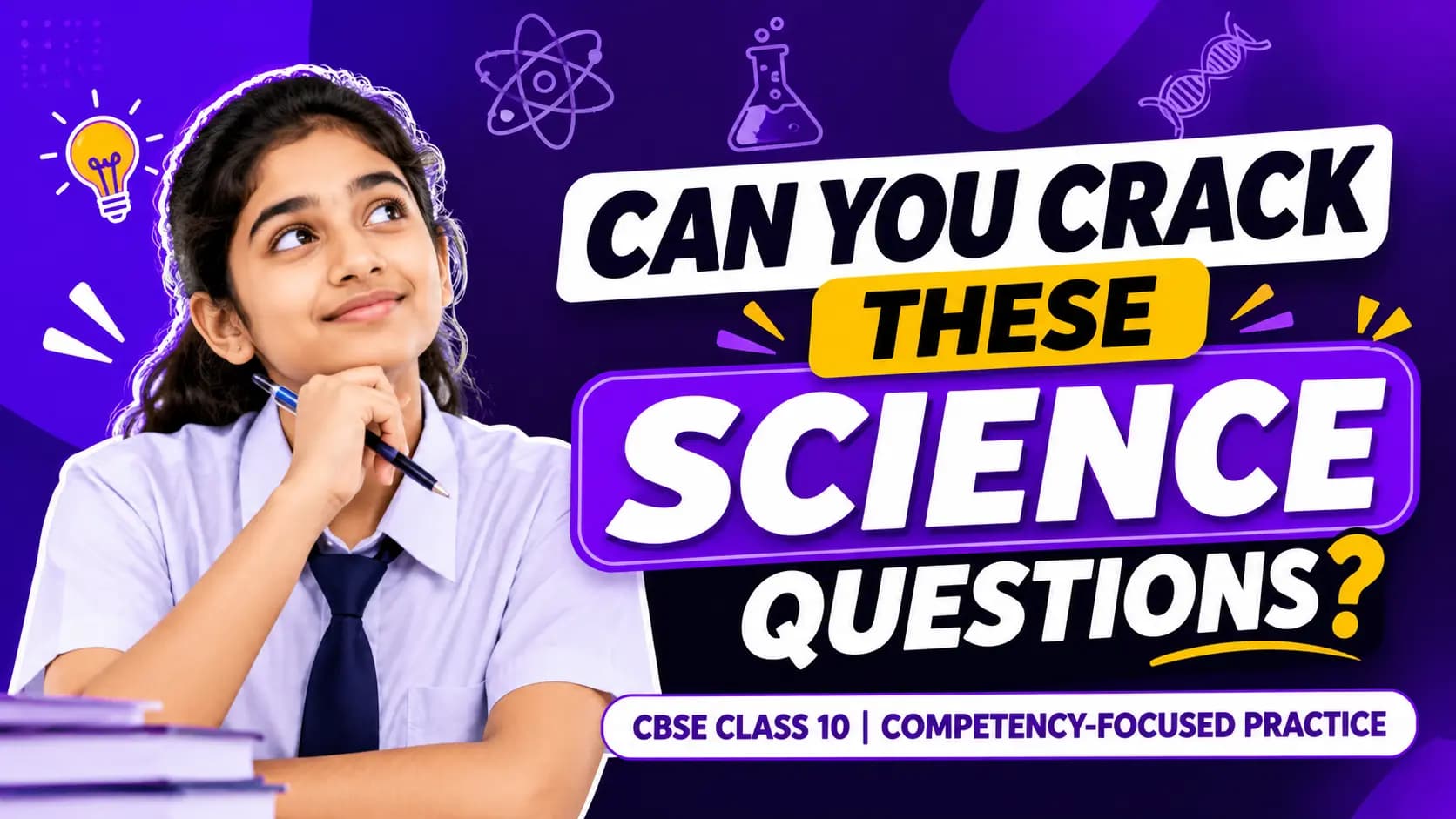
Competency Focused Practice Questions (CFPQs) are CBSE's practice questions that test whether you can apply Science concepts to real situations, not just recall textbook answers. This guide shows you where to get chapter-wise CFPQs for Class 10 Science and how to learn them, from solving them step by step to avoiding common mistakes and planning your practice.
Class 10 Science CFPQ Questions Chapter-Wise
What to practise in 2026–27
The 2026–27 board exam covers 13 chapters in 5 units. Some CFPQs published before the latest syllabus changes cover chapters that have since been removed. The links below follow the current syllabus, so you spend time only on what is examined.
Skip these topics for 2026–27. According to the research we compiled from syllabus analyses, they are outside the board paper:
- Periodic Classification of Elements
- Evolution (inside Heredity and Evolution)
- Sources of Energy
- Sustainable Management of Natural Resources
- Electric motor, electromagnetic induction and electric generator (inside Magnetic Effects of Electric Current)
Subject pages
Chemistry (25 marks in the board paper)
| Chapter | What to practise |
|---|---|
| CBSE Class 10 Chemistry Chapter: Chemical Reactions and Equations | Practise balancing equations and identifying types of reactions in everyday situations. |
| CBSE Class 10 Chemistry Chapter: Acids, Bases and Salts | Apply pH and the properties of acids, bases and salts to daily-life examples. |
| CBSE Class 10 Chemistry Chapter: Metals and Non-metals | Work through questions on the reactivity of metals, corrosion and how metals are extracted and used. |
| CBSE Class 10 Chemistry Chapter: Carbon and Its Compounds | Practise combustion, esters and the naming of carbon compounds. |
Biology (30 marks in the board paper)
| Chapter | What to practise |
|---|---|
| CBSE Class 10 Biology Chapter: Life Processes | Explain how digestion, respiration and transport work in living organisms. |
| CBSE Class 10 Biology Chapter: Control and Co-ordination | Practise questions on the nervous system, hormones and plant responses (tropisms). |
| CBSE Class 10 Biology Chapter: How do Organisms Reproduce? | Work on reproduction questions, a frequent source of long answers. |
| CBSE Class 10 Biology Chapter: Heredity | Practise Mendel's laws and sex determination. Evolution is not part of the 2026–27 exam. |
| CBSE Class 10 Biology Chapter: Our Environment | Solve questions on food chains and the 10% energy transfer between levels. |
Physics (25 marks in the board paper)
| Chapter | What to practise |
|---|---|
| CBSE Class 10 Physics Chapter: Light: Reflection and Refraction | Practise ray diagrams and numericals on mirrors and lenses. |
| CBSE Class 10 Physics Chapter: The Human Eye and the Colourful World | Apply the working of the eye, vision defects and dispersion of light. |
| CBSE Class 10 Physics Chapter: Electricity | Solve circuit questions on resistance, current and power. |
| CBSE Class 10 Physics Chapter: Magnetic Effects of Electric Current | Practise magnetic field lines and domestic electric circuits. |
Why Science CFPQ Matters for the Class 10 Board Exam
New to the format? Start with our guide to competency focused practice questions for Class 10. Here are five reasons to practise CFPQs:
- About half the paper tests competencies. Prep portals report that CBSE now sets about 50% of Class 10 questions to test how you apply concepts, which is exactly what CFPQs train. Some older pages still say 30%, which is outdated. The figure of about 20% usually refers only to the highest thinking level (analyse, evaluate, create).
- It fixes the "understands in class, loses marks in the exam" problem. Parents tell us this again and again. A common pattern is a child who can answer direct questions but struggles when the same idea is asked indirectly. CFPQs are built around indirect, real-life questions.
- It exposes rote learning early. Many parents notice that marks drop suddenly when a child who has memorised answers meets application questions. CFPQs show this gap while there is still time to fix it.
- It matches the new paper layout. From 2025–26, CBSE's Science paper (80 marks, 3 hours, 39 compulsory questions) is split by discipline.
- Marks are given in small steps. CFPQ marking schemes award 0.5 and 1 mark for formulae, balanced equations, substitution and units. Practising with them teaches you to collect these marks.
Want to see how the 80 marks are divided across Biology, Chemistry and Physics? Read the Class 10 Science paper pattern 2026 breakdown.
Two things students often ask
Are there two board exams for Class 10? CBSE has introduced two board exams for Class 10 from 2026. This is a different question from CFPQ practice, so check the current CBSE circular for dates.
Is there a "Science Advanced" paper? An optional "Science Advanced" paper is reported for 2027–28 onwards. It does not apply to students sitting the 2026–27 exam.
Get Class 10 Science CFPQ Questions on Hello Angle (Self-Learning)
Many students can learn CFPQs on their own, without a teacher's help, if they have a clear way to practise. If you are one of them, you can use the Hello Angle platform to learn and practise competency focused practice questions at your own pace. The practice pages are arranged by subject (Biology, Chemistry, Physics) and then by chapter, so you can work on exactly the chapter you have just studied. Need extra practice material? See the best books for Class 10 competency practice.
Follow these steps to learn CFPQs on your own, step by step:
- Open your subject page (Biology, Chemistry or Physics) and pick the chapter you have just studied.
- Study the NCERT chapter first. CFPQs test application, so they work best after you know the concepts.
- Attempt the questions without looking at answers. Write the working in your notebook, as you would in the exam.
- Check each answer. For every mistake, note whether it was a concept gap, a calculation slip, a missing unit or a misread question.
- Return to missed questions after 3–4 days to see whether the correction stuck.
- Finish with the sample paper. Once all chapters are done, attempt the official 2026–27 Sample Question Paper in one 3-hour sitting.
Self-learning works well when you can find and fix your own mistakes. If you keep getting stuck on the same concept for several days, that is the signal to ask a teacher for help.
Stuck on a CFPQ? Learn Faster with a Teacher by Your Side
Not every student finds CFPQs easy to learn alone. Because these questions put a concept in a new situation, it is common to understand the chapter well and still not know how to begin an answer. Practising on your own then turns into guessing, and the same mistakes repeat.
Support from a teacher helps when:
- You understand the chapter but cannot work out what a CFPQ is really asking.
- You keep losing marks on the same steps, such as the formula, the unit, a balanced equation or a diagram.
- Assertion-Reason and case-based questions take too long or leave you unsure.
- Your marks are inconsistent even though you practise regularly.
- Your exam is close and you need to know which chapters to focus on first.
How an expert teacher helps with CFPQs
A teacher can explain the idea behind a question you got wrong, show how to read a graph, an experiment or a passage, and point out exactly where your answer lost marks. They can also guide your practice chapter by chapter, so you know what to practise next and how to write a full-mark answer.
Connect with Angle Tuition
If you need support and assistance while learning and practising CBSE Class 10 Science CFPQ, you can connect with Angle Tuition for expert teacher guidance and support, in one-to-one online classes with a teacher focused on your child.
Common Mistakes to Avoid When Answering CFPQ Science Questions
These six mistakes cost students the most marks in CFPQ-style questions. Each one is easy to fix once you know about it. To see the kinds of questions CBSE sets, read about CBSE Class 10 competency questions 2026.
- Writing a memorised answer instead of reading the situation. A CFPQ describes a new situation, so a learnt NCERT answer rarely fits as it is. Before writing, ask which concept the question is really testing, then apply it to the situation given.
- Leaving out the formula, substitution or unit in numericals. These steps are marked separately, so a correct final number with no working can still lose marks. Write Given → Formula → Substitution → Answer with the SI unit every time.
- Not balancing chemical equations. Balancing carries its own mark in the marking scheme, so an unbalanced equation loses it even if the products are right. After writing an equation, count the atoms of each element on both sides.
- Skipping diagrams or leaving them unlabelled. Ray diagrams, circuit diagrams and diagrams of the neuron or digestive system earn marks of their own. Draw them neatly and label every part that the question mentions.
- Reading Assertion and Reason together. When you read both statements at once, you tend to assume one explains the other. Decide whether the Assertion is true on its own, then whether the Reason is true on its own, and check for a link only if both are true.
- Searching the passage for the answer in case-based questions. The passage only sets the scene. The answers come from the concepts you learned in NCERT, applied to that scene. Read the passage once, then answer each sub-question separately.
A Study Plan for Using CFPQs (and When to Start)
For every chapter (about 2–3 sittings)
- Learn the NCERT chapter and solve its in-text questions.
- Practise 10–15 CFPQs from the Hello Angle chapter page.
- Mark yourself against the answer key, writing the full steps.
- Log every error under Concept, Calculation, Presentation or Time.
- Revisit the wrong questions after a few days.
Across the year
| Stage | Focus |
|---|---|
| While the school syllabus runs | One chapter at a time, in the order your school teaches |
| After syllabus completion | Mix chapters within each section (Biology, Chemistry, Physics) |
| 6–8 weeks before boards | CFPQs and the additional practice paper on weak chapters |
| Final 4 weeks | Two or three timed sample papers, graded against the marking scheme |
Use your error log
If most errors are Presentation, practise writing full-step answers. If they are Concept, go back to the chapter or ask a teacher. If they are Time, practise Biology, Chemistry and Physics separately with a timer.
Starting late
Starting late is fine. A chapter-priority plan built around your weakest units can still help. Ask the teacher to focus on the highest-mark units first.
Frequently Asked Questions About CBSE Class 10 Science CFPQ
What is CFPQ in CBSE Class 10 Science?
Where can I get CBSE Class 10 Science CFPQ questions?
Are CFPQs important for the Class 10 board exam?
Will the same CFPQ questions come in the board exam?
Do I need to practise CFPQs from every chapter?
How many CFPQs should I practise for each chapter?
How do I solve Assertion-Reason questions?
How should I answer case-based questions?
Do CFPQs come with answers and marking schemes?
When should I start CFPQ practice, and what if my exam is close?
Related Blogs
- CBSE Competency Focused Practice Questions Class 10
A wider overview of CFPQs for Class 10 and how they fit into your board exam preparation.
- How to Solve Case Study Questions: CBSE Class 10
A step-by-step method for case-based questions, which appear in the Science paper.
- CBSE Class 10 Science Paper Pattern 2026
A clear breakdown of how the Science paper is divided across Biology, Chemistry and Physics.
Latest Blogs
- CBSE Class 12 Physics Weightage 2026-27: Chapter-Wise Marks
- IGCSE Results 2026 , Release Date, Time & Complete Guide

- CBSE Class 12 Re-evaluation Results 2026
- Types of Scholarships for CBSE and ICSE Students in India & GCC 2026

- NCERT New Book Class 9 Maths (2026,27) Ganita Manjari
- What Happens If You Fail Additional Subject in CBSE Class 12?
- CBSE Competency Focused Practice Questions: Free PDFs
- Best Books for CBSE Class 10 CBQ Practice 2026: Oswaal vs Educart vs Arihant
- How to Correct CBSE Admit Card Mistakes Quickly

- Top 3 NEET Coaching Centres in Kerala